How Headroom HQ Works - The Complete Guide
Learn how Headroom HQ works, including the two assessments, the HQ Library, the fictional HQ Universe, the HQ Vault, HQ Store, and how they connect to produce measurable operational improvement.
Most operations intelligence content feels the same way. You read a framework, nod along, and close the tab. Nothing changes. The content was too generic to apply, too abstract to act on, or too disconnected from your actual situation to tell you where to start.
The other failure mode is diagnostic without direction. You take an assessment, receive a score, and sit with a number that does not tell you what to read, what to implement, or what to do first.
Headroom HQ is built to fix both problems in a single connected system: a diagnostic that identifies where your operation stands, content that maps directly to that diagnosis, and a 90-day improvement structure that takes you from current state to measurable change.
Every piece of Headroom HQ — the assessments, the content library, the fictional universe, the HQ Vault, and the HQ Store — is designed to support one goal. This page explains how all of it connects.
Who This Is For
Headroom HQ is built for mid-market operations leaders in companies between $15M and $150M in annual revenue who are accountable for how the business actually runs.
It includes COOs, VPs of Operations, Directors of Operations, and operationally active founders. It also includes PE-backed operators working against exit timelines and bootstrapped founders trying to systematize an organization that currently depends on their personal bandwidth.
Who This Is Not For
Headroom HQ is not designed for early-stage startups with premature operational processes, enterprise operations teams with dedicated infrastructure support, or operators primarily looking for task management tools.
The operational challenges Headroom HQ addresses — process documentation at scale, key person dependency, measurement sophistication, technology coherence, and decision rights — are specific to the operating realities of mid-market organizations.
They exist because the company has grown past informal systems but has not yet built institutional ones.
Why Fictional Companies
This is not a convention borrowed from business education. It is a deliberate editorial design decision, and it deserves a direct explanation.
When a documented failure is published about a named company, the most common response from operations leaders is, "Our situation is different." That dismissal ends the analysis before it can be applied. The specifics of another company's industry, leadership structure, or market timing become the reason the lesson cannot transfer.
A fictional company operating at a recognizable scale with a recognizable operational problem removes that exit. The question changes from "How is this company different from ours?" to "Which of our operational decisions resembles this one?"
The fictional format also makes possible something real case studies structurally cannot deliver: narrative continuity across time. A real published case study ends at the point of failure or resolution.
Headroom HQ's companies continue operating. You follow the decision that created the problem, the moment it became visible, the organizational response, and the downstream consequences — across multiple issues, multiple characters, and multiple quarters.
That continuity is what makes the analysis operational rather than retrospective. The lessons do not arrive as post-mortems. They arrive in the middle of a decision cycle, which is when they are most useful.
Every company and character in the HQ Universe represents a specific operational pattern — not to tell a story for its own sake, but to make that pattern concrete, recognizable, and applicable across different organizations.
The Headroom HQ Ecosystem
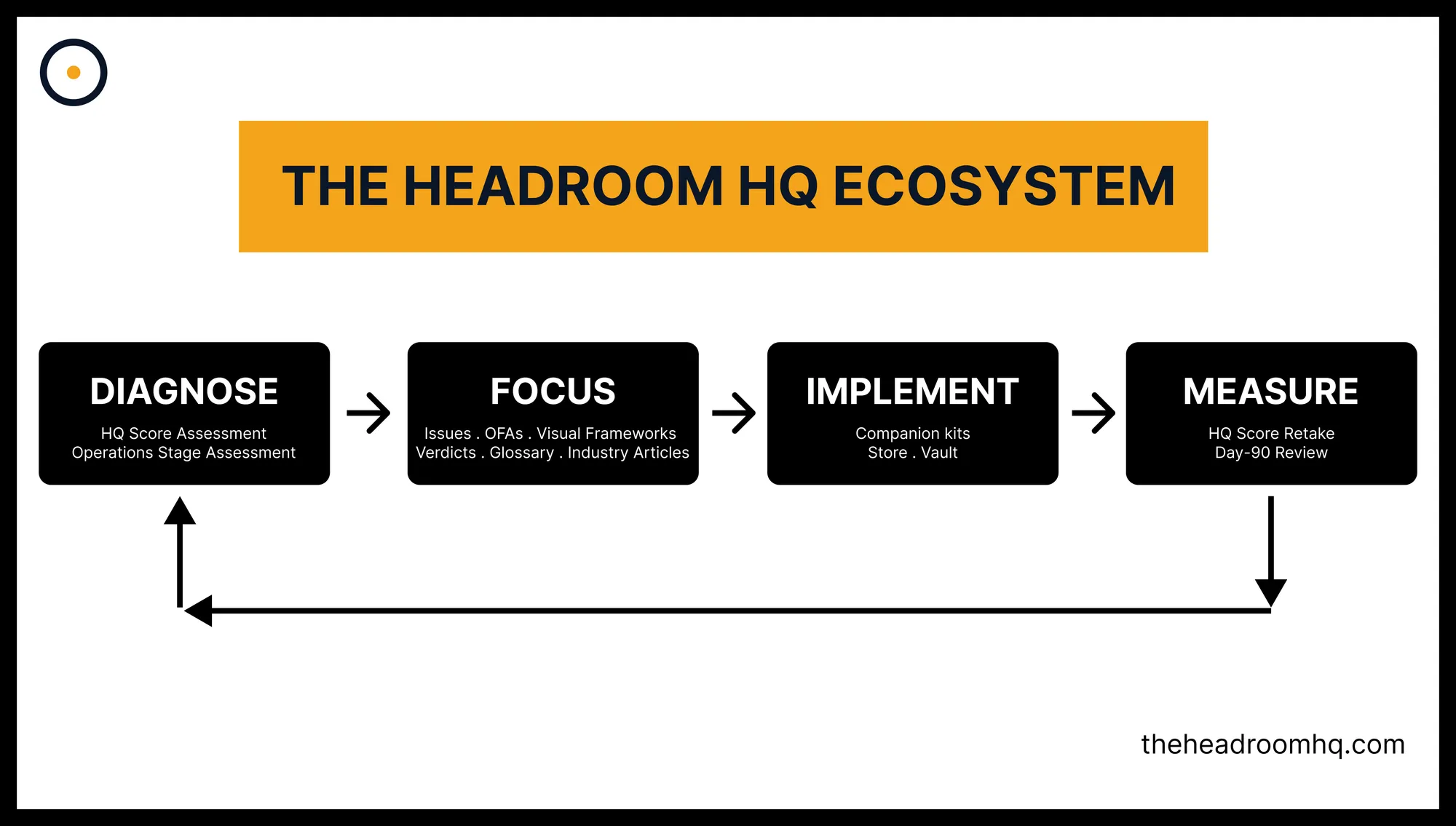
The diagram below maps how every component of Headroom HQ connects to a single 90-day improvement cycle.
- The Operations Stage Self-Assessment gives you stage context.
- The HQ Score tells you where to start.
- The HQ Library tells you what to read.
- The HQ Vault gives you deeper connected intelligence to investigate.
- The HQ Store gives you tools to act.
The cycle closes when you retake the HQ Score Assessment and measure what changed.
Your First Week
If you are new to Headroom HQ, this is your entry sequence. Three steps. No financial commitment required.
Step 1: Take the 5-Question Operations Stage Self-Assessment
Three minutes. It identifies which of the four operational stages closely describes your operation right now. It gives you the context you need to interpret everything that follows, including your HQ Score results.
Step 2: Register for the HQ Score Assessment - Early Access (Email-only)
The HQ Score launches in Q1 2027. The HQ Score - Early Access registration includes:
Immediate Access: OFA-02 (Southwest Airlines), OFA-03 (Knight Capital Group), and The Operations Leader's AI Evaluation Framework — subscriber-exclusive content available from the moment you subscribe.
At HQ Score launch: You are notified the day the HQ Score goes live, before the general announcement.
Step 3: Read one OFA story mapped to the dimension you think is most required at this point
The Operational Failure Archive shows what neglect of a specific operational dimension looks like in documented real-world cases. Starting with a failure entry for your priority focus area gives you a concrete operational consequence to work backward from before you begin the implementation content.
If no OFA currently exists for your specific priority focus area, you can start with the Issue listed on your dimension page instead.
The sequence — under 15 minutes of time — gives you your operational stage, early access to HQ Score, immediate access to subscriber-exclusive content, and a documented failure case for your most urgent gap.
You are oriented in the Headroom HQ ecosystem before you have spent a dollar.
The Assessment
Headroom HQ provides readers with two operational assessments. They serve different purposes and they work together.
The 5-Question Operations Stage Self-Assessment
Three minutes. Five questions. Identify your operational stage.
This assessment tells you where you are in the operational stage model — Builder, Systematiser, Delegator, or Strategist. It does not tell you why you are there or which specific operational dimensions are keeping you at that stage.
It is the fastest entry point into the Headroom HQ ecosystem and the context layer makes your HQ Score result interpretable.
The HQ Score Assessment
Thirty questions. Ten Operational Dimensions. Ten minutes.
Your total HQ Score and your operational stage are displayed immediately on the results page. You can share your email on the results page to receive your priority focus areas and the specific Headroom HQ resources matched to each priority focus area. We typically send this within 1 business day.
The HQ Score Assessment measures your operation across ten dimensions, which are as follows:
- D01 - Process Documentation Coverage
- D02 - Key Person Redundancy
- D03 - Vendor Contract Quality
- D04 - Team Structure Clarity
- D05 - Measurement Sophistication
- D06 - Technology Coherence
- D07 - Decision Rights Clarity
- D08 - Meeting Design Quality
- D09 - Onboarding Effectiveness
- D10 - Operational Leverage
Your priority focus areas — the dimensions scoring lowest on your assessment — determine what you read, what you implement, and what you measure in the 90-day cycle that follows.
Register for HQ Score - Early Access and avail subscriber benefits as well.
Which Assessment to Take
First time here
- Take the Operations Stage Self-Assessment first, then the HQ Score assessment within the same week.
- The operation stage gives you the frame. The HQ Score gives you the specific gaps. Together they produce the complete operational diagnosis.
Already have your HQ Score
- Skip the Operations Stage Self-Assessment. Go directly to your priority focus area's dimension page and navigate the HQ Library from there.
Retaking after 90 days
- Retake the HQ Score Assessment only. Compare your new results against your previous HQ Score to confirm whether implementation produced measurable change.
- We recommend revisiting the assessment every 90 days to track progress.
The Quarterly Improvement Cycle
Headroom HQ is built around a 90-day improvement cycle.
The assessments, the content library, the HQ Vault, and the HQ Store are all components of this improvement cycle — not independent products. Understanding the cycle is the most direct way to understand how every other element connects.
Diagnose
- Register for the HQ Score Assessment - Early Access.
- Once the HQ Score is live, you can complete the assessment and share your email on the results page to receive your priority focus areas.
- Read the dimension page for each priority focus area.
- If you are new, take the Operations Stage Self-Assessment first to establish the context in which your HQ Score sits.
Focus
- Navigate the HQ Library using your priority focus areas as the filter. The dimension page lists the most applicable Issues and OFA entries, along with related glossary terms and HQ Store products.
- Start with the OFA entry for your priority focus area. It shows what operational failure looks like when that dimension is neglected.
- Read the most relevant Issue and explore its supporting Verdict or Visual Framework.
Implement
- Use the most relevant HQ Store tool mapped to your priority focus area.
- Every product in the HQ Store is mapped to the dimension it most directly helps improve.
- If no such tool currently exists for that dimension, the free products in the HQ Store for that dimension are the starting point.
Measure
- At the 90-day mark, retake the HQ Score Assessment.
- Your updated HQ Score tells you whether the implementation produced measurable change.
Diagnose Again
- The second assessment either confirms improvement and suggests moving to the next priority focus area or reveals that the original dimension requires continued focus before moving on.
This cycle is the mechanism through which Headroom HQ users convert operational intelligence into measurable operational improvement.
The HQ Library
Every piece of content in the Headroom HQ Library maps to one or more of the ten HQ Score dimensions. Once you have your priority focus areas, the HQ library becomes a directed activity rather than a browsing exercise.
The abbreviations displayed in square brackets identify each content type used across the HQ Library.
Here is when to reach for each content type.
Issues [Issue]
Issues are the narrative core of the HQ Library — they show how operational problems develop, compound, and resolve across time. Six fictional mid-market companies navigate real operational challenges across monthly published issues. Every Issue maps to a primary HQ Score dimension.
Reach for Issues when you want to follow an operational decision from the moment it is made through its downstream consequences.
Issues 01–06 are fully available to all readers, including both Part A and Part B. From Issue 07 onwards, Part A is available to all readers, and Part B is available exclusively to free subscribers.
Each Issue has two supporting components available exclusively to HQ Vault members from Issue 02 onwards: the corresponding Verdict and Visual Framework.
Verdict [V]
- Structured editorial positions on specific operational situations derived from each Issue. Each Verdict focuses on a single complicated decision and delivers a definitive position — not "here are the considerations" but a specific answer with the reasoning behind it.
- Reach for Verdict when you need a clear position on an operational decision rather than a framework for thinking about it.
Visual Framework [VF]
- Single-page reference architectures derived from each Issue, mapped to HQ Score dimensions and designed for use during implementation rather than just reading. Built to be printed, added to a Notion workspace, or shared with a team before a planning session.
- Reach for Visual Frameworks when you need a reference format for a team conversation or a post-issue implementation session.
Operational Failure Archive [OFA]
Documented operational failures at real named companies, built from primary sources including SEC filings, court records, regulatory orders, and official investigation reports.
Each OFA maps the failure to specific HQ Score dimensions, identifies the earliest visible warning signal before the failure crystallized, and extracts operational lessons directly applicable to mid-market companies.
Reach for OFAs when you want to understand what a specific operational failure actually looks like — before it becomes visible, as it develops, and in its consequences. The OFA entry for your priority focus area is the recommended starting point for each new 90-day improvement cycle.
Frameworks
Standalone operating models designed to evaluate and simplify specific organizational problems. Unlike Visual Frameworks, which are derived from Issues, Frameworks are independent resources applicable across companies and situations without requiring familiarity with any specific Issue.
Reach for Frameworks when you need a structured model for a specific operational decision that stands alone from the Issue library.
Industry Articles [IA]
Exploration of the systems, processes, and operational decisions that shape mid-market performance across industries.
Reach for Industry Articles when you want context on how a specific operational challenge manifests across sectors, or when you want to benchmark your organization's approach against broader industry patterns.
Glossary
A 109-term vocabulary guide for the concepts, systems, and operational terminology used across Headroom HQ. Each term maps to one or more HQ Score dimensions and connects to related content across the Headroom HQ ecosystem.
Reach for the Glossary when you encounter a term in any Headroom HQ content that requires definition, or when you want to trace how a specific concept connects across multiple dimensions.
The HQ Vault
The HQ Vault is the operational intelligence membership that contains the full depth of the Headroom HQ ecosystem:
- The complete Operational Failure Archive, with new entries every other month
- Verdicts and Visual Frameworks from Issue 02 onwards, published monthly
- Dimension View — the investigation layer that surfaces related content across all dimensions for a specific gap you are researching
- All six HQ Universe Company Reference Cards and 18 Character Reference Cards
- Issue Companion Kits, delivered to Vault members at no cost when they launch
- Future Vault-exclusive releases while your membership remains active
The HQ Vault is accessed through Systeme.io. Login credentials are delivered by email after you join.
The HQ Vault membership is $29/month or $290/year at the founding rate for first 50 members only. Annual members receive 2 months free.
The founding members lock in the current pricing permanently for as long as their subscription remains continuously active. Once the 50 founding seats are filled, the founding offer closes and new members join at the standard rate.
The HQ Store
The HQ Store contains operational templates, courses, scorecards, and checklists organized by HQ Score dimension. Every product maps to the dimension it most directly helps improve.
The correct starting point is your HQ Score priority focus areas, not the Store catalogue. Once you have your priority focus areas, the dimension pages show the products most relevant to improving each specific gap.
Comprehensive individual products ($39–$99) go deeper into the implementation details. Bundles ($149–$349) address multiple dimensions in a single purchase.
Issue Companion Kits — detailed implementation packages built for specific Issues, priced at $49 per kit and delivered to HQ Vault members at no cost when they launch.
Free products are available across most dimensions. These are starting points that require no financial commitment. Paid products go deeper into the implementation details the free products introduce.
Questions?
Search the Headroom HQ Help Center for instant answers related to common queries regarding HQ Score, HQ Vault and HQ Store.
OR
Visit the HQ Ask chat on any page at theheadroomhq.com and fill out the contact form.
OR
Email us at hello@theheadroomhq.com with your queries. We typically respond within 1-2 business days, Monday through Friday.
Comments ()